

These ten AI-generated artworks from Alpha Christian Art depict Saint Joseph in prayer, with a lily or flowering staff, and caring for the Child Jesus. Use the guide to compare each composition and choose the gesture, palette and scale that suit your space.
Read Joseph’s first dream in Matthew 1 · Read the Flight into Egypt in Matthew 2
Choosing a Saint Joseph art print
A portrait with a lily is easy to identify across a room. For a small prayer corner, consider a closer composition where the hand, eyes or child’s posture remain legible at a modest size. Dark blue and crimson paintings benefit from even light, and an outdoor image with a broad field gives its setting more room when printed larger.
1. The Lily across the Sienna Mantle
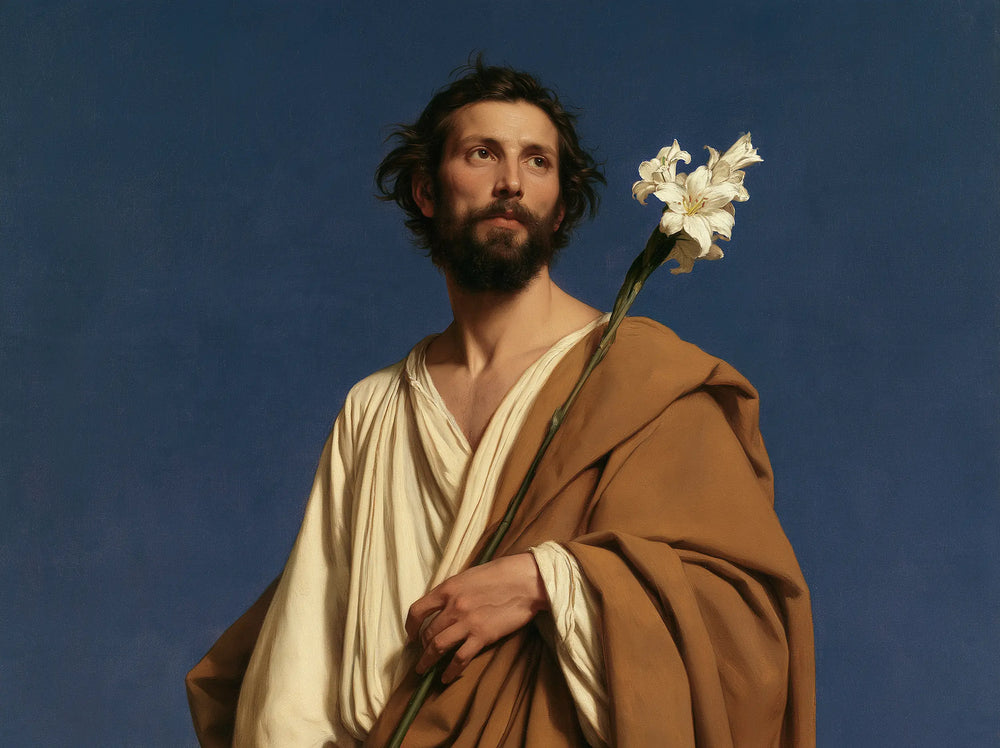
The pale lily crosses the warm sienna mantle, making the flower readable before its individual petals come into view. That strong diagonal gives this portrait a clear silhouette for a narrow wall or a small prayer corner.
2. The Upward Gaze beside the White Lily

The lifted head gives this portrait a sense of attention beyond the frame. The lily anchors the lower area, so the eye can move between expression and emblem without the picture feeling crowded.
3. The Infant Turning toward the White Flowers

Here the child’s interest in the flowers helps tell the story of the relationship. The lily becomes part of an exchange between the figures. A print displayed at eye level makes that small turn of the head easy to see.
4. The Fatherly Gaze above the Resting Child

Joseph’s downward gaze sets the pace. Compare the angle of the head with the child’s resting posture to see how the scene communicates care through body language. A modest format suits this close view.
5. The White Flowers against the Deep Blue
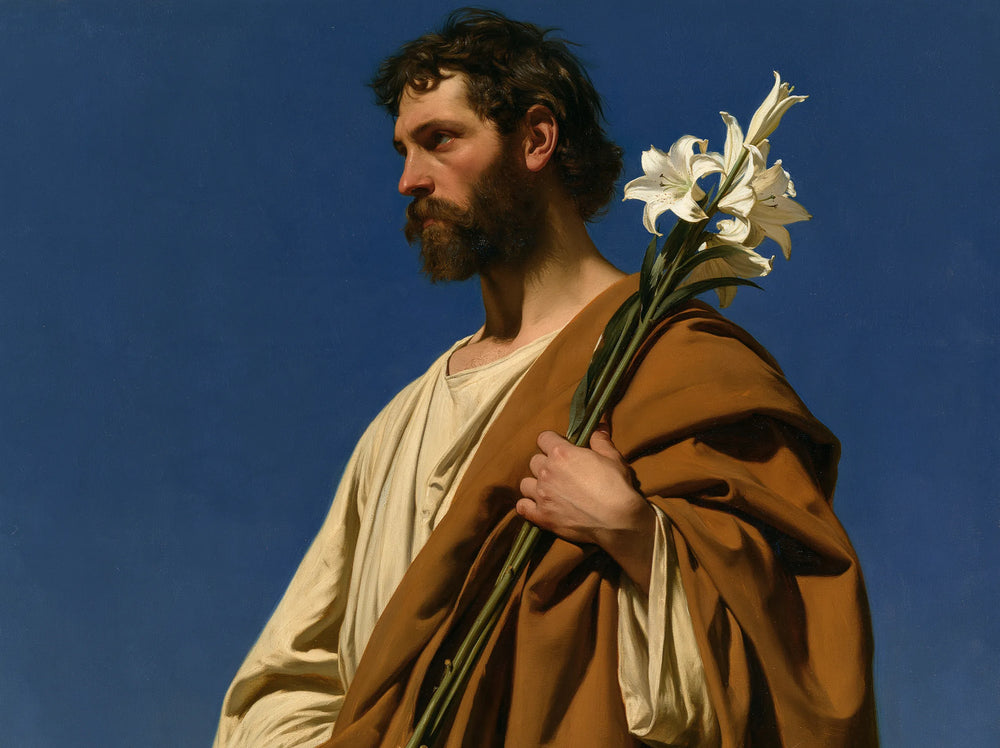
White flowers stand out clearly against the blue ground. The limited palette gives the print a calm appearance and allows it to sit alongside another devotional image with cooler colors. Even light will help preserve the blue’s depth.
6. The Green Mantle across the Wildflower Field

In this outdoor scene the mantle belongs to a broader field of green. That makes the setting worth seeing at a comfortable distance. Leave enough wall space around the print for the landscape and figure to read together.
7. The Child Resting against the Flowering Staff

The flowering staff rises beside the resting child and gives the group a strong vertical. The staff has a history in images of Joseph’s betrothal. Here it also balances the weight of the child’s body in the composition.
8. The Resting Infant in the Golden Fold

Golden folds surround the child and set off the softer tones of the face. A neutral frame gives that warmth room and makes it easier to pair the print with a picture of the Holy Family.
9. The Little Hand against Joseph’s Robe

A small hand against Joseph’s robe becomes the focus of the scene. It shows closeness through touch. This is particularly suited to a place where the viewer can stop and look at the picture nearby.
10. The Folded Hands beneath the Crimson Light
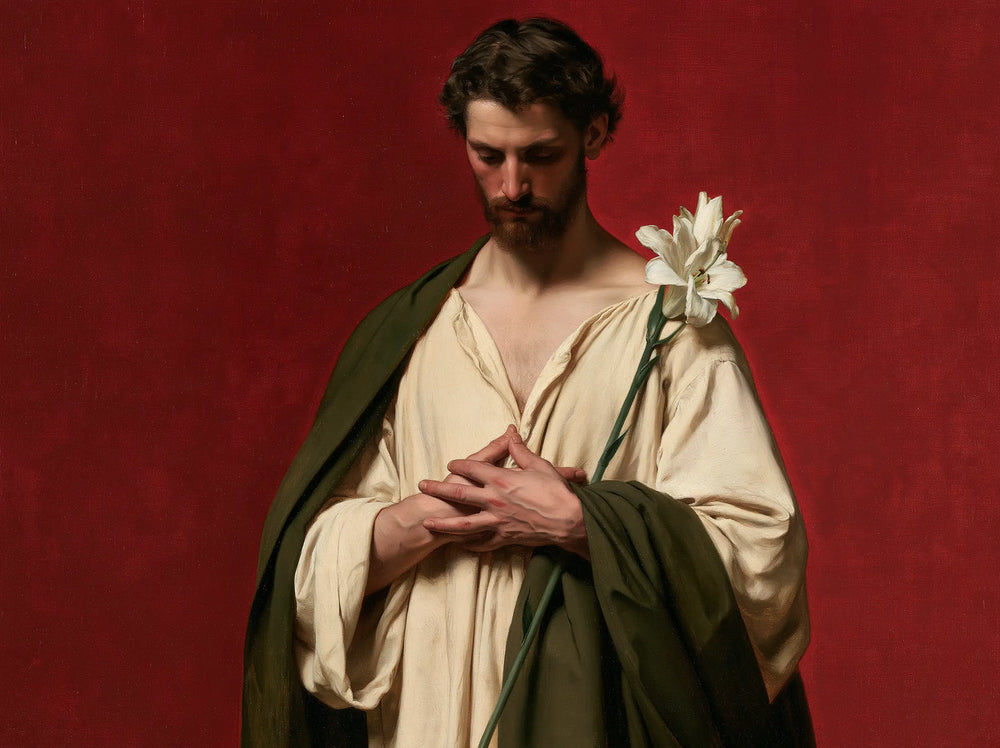
The folded hands make this a prayerful image of Joseph on his own. Crimson gives the scene a warmer character than the cobalt and blue portraits in the selection, while the gesture keeps the emphasis on quiet attention.
Why is Saint Joseph shown with lilies?
The white lily became a devotional emblem of purity. In some works Joseph carries a flowering rod, associated with the tradition of his betrothal to Mary. Matthew tells the story of Joseph’s dreams and the flight into Egypt without describing either flower. The flower belongs to the language of the image and can help identify the saint even in a simple portrait.
Read Getty’s guide to Saint Joseph’s attributes
Explore more Holy Family art
See historical Saint Joseph paintings →
Holy Family paintings · Flight into Egypt paintings · Shop the Saint Joseph collection